
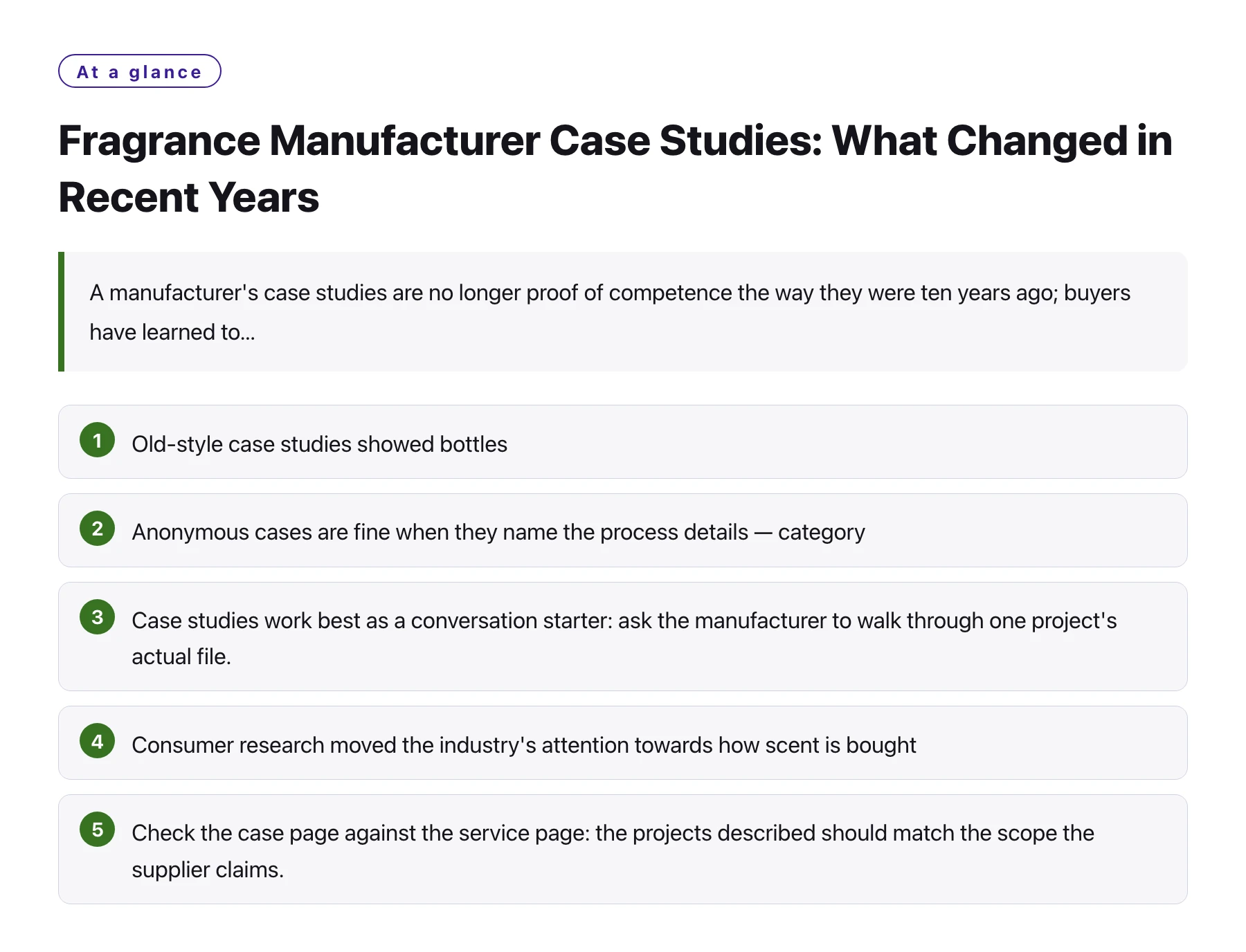
A manufacturer's case studies are no longer proof of competence the way they were ten years ago; buyers have learned to read them as marketing, and manufacturers have learned to write them as evidence. The useful case study today documents process — what was developed, what was verified, what survived production — instead of showing a pretty photograph. Judge a supplier by whether its cases answer your questions, not by how many there are.
Key takeaways
- Old-style case studies showed bottles; the useful ones now show decisions, constraints and outcomes.
- Anonymous cases are fine when they name the process details — category, scale, timeline — that tell you whether the project resembles yours.
- Case studies work best as a conversation starter: ask the manufacturer to walk through one project's actual file.
- Consumer research moved the industry's attention towards how scent is bought, and case studies now mirror that shift.
- Check the case page against the service page: the projects described should match the scope the supplier claims.
A decade ago, evaluating a fragrance manufacturer meant flipping through a portfolio book: famous client names, glossy pack shots, press clippings. The implicit question was "who have they worked with?" — the assumption being that the answer predicted what they could do for you.
That assumption has weakened for good reasons: confidentiality agreements pushed many names off the pages, buyers got better at seeing through stock photography, and the industry moved its attention from who a supplier served to how it worked. A case study became a different document. This article maps that change and how to use the new-style case study in an evaluation.
What case studies used to prove
The old portfolio answered one question: is this a serious company? A wall of names and awards was read as a credential, and the reader supplied the rest of the story themselves. It worked as marketing because it worked on status.
What changed is what buyers now compare against. Manufacturers like Xuelei moved their portfolios and service scopes online early, which made it trivial to check a claimed case against a stated scope — and the mismatch between the two became a red flag instead of a footnote Xuelei. When everything can be cross-checked in minutes, the credential alone stops being persuasive.
Old signals, new signals
| What used to impress | What signals competence now |
|---|---|
| A wall of famous client names | Process detail: category, volume, timeline |
| Glossy pack shots | Files you can ask to see: stability, batch records |
| Press quotes and awards | A repeatable workflow and revision discipline |
| A long client list | Fit with your category, market and price tier |
None of the right-hand column is hard to fake either — which is exactly why the follow-up question matters more than the page.
Why the industry shifted
Consumer research changed the questions
Fragrance buying research now tracks how people discover and choose scent — shelf behaviour, discovery sets, seasonal patterns — and that research is published by consumer-intelligence firms such as Mintel [1]. Manufacturers absorbed the shift: their case stories now talk about the shopper the product was built for, not just the juice.
Education changed the audience
The Fragrance Foundation and similar bodies run fragrance education and awareness programs that have produced more literate buyers [2]. A buyer who can discuss accords and stability expects a case study to discuss process — and suppliers that still sell status get tuned out.
Regulation changed the evidence
Markets demand traceability, so the interesting case studies now include the paperwork: IFRA mapping, batch records, stability summaries. The manufacturing location shapes that evidence too — a project documented by a perfume production partner in China carries a different regulatory context than one made in the EU, and a good case study says which one the reader is looking at perfume production partner in China.
The most useful case study is the one you get on a call: show me a project that went wrong and what you changed. Manufacturers with real processes answer that calmly, because the file exists. The rest change the subject.
How to use cases in an evaluation
Read any case page with three questions in hand. First, does it name process facts — category, scale, timeline — or only adjectives? Second, can the supplier show the workflow behind one published case, even anonymised? Third, does the case match the scope the supplier claims on its service pages?
A manufacturer that publishes its client portfolio and project categories, such as the page presenting Xuelei's brand partners, gives you a concrete starting point for that third check — you can compare what it says it does with the kinds of projects it shows Xuelei's brand partners.
And remember the asymmetry: a case study is the supplier's selection of its own work. The question is not whether the selection is flattering, but whether the process behind one selected case survives your follow-up call. If it does, the page has done its job.
A final habit worth adopting: keep the case pages you collected during an evaluation. Twelve months into a relationship, the case study that impressed you becomes a useful checklist — did the supplier deliver the timeline it showed, the documentation depth it implied, the category fit it claimed? The suppliers that look best in the pdf are not always the ones that look best in the batch record, and comparing the two is how you learn to read cases faster next time.
Sources
- Mintel Press Centre —— Mintel's press releases on consumer and beauty market research, including fragrance and personal care trend reporting.
- The Fragrance Foundation —— A non-profit organisation for the fragrance industry, running perfumery education programmes and industry recognition.
Frequently asked questions
Should I trust case studies that name famous brands?
Be curious, not impressed. Named clients can be relevant, but the name alone proves nothing about your project. Ask what the supplier actually did for that brand and whether the process resembles what you need.
Why do so many manufacturers anonymise their cases?
Confidentiality agreements are the usual reason. Anonymity is not a red flag by itself — what matters is whether the process detail survives the anonymisation.
What is the difference between a case study and a portfolio?
A portfolio shows finished products; a case study shows decisions and outcomes. The second is harder to fake and more useful to a buyer, which is why its rise tracks the industry's move towards process evidence.
How many case studies should a credible supplier have?
Depth beats count. One case that documents process in your category is worth more than twenty glossy pages from other markets.
Can I ask to speak to a referenced client?
You can ask, and a confident supplier will arrange it under NDA. If they cannot, proceed with the process evidence instead — it tends to be a better predictor anyway.