
A First Container Without Surprises: Practical Order Steps
A first container is won or lost on paperwork that is finished before the goods are pressed. Dongstar Wood publishes monthly supply capacity above 100 × 40ft across 16+ automated production lines, and a buyer who fixes the specification, the sample and the document set in that order can place a trial order inside a running production schedule.
Key takeaways
- Write the specification first: sizes from 1220 × 2440 mm to 1500 × 3000 mm, thickness 9–30 mm, glue classes E0 to Phenolic Dynea.
- Ask for a sample from a running batch, not a cut made for the quotation, and record its batch reference.
- Confirm packing and inspection in writing: export-standard wrapping, steel banding and timber pallets are the published baseline.
- Assemble the document set early: certificates, the EUDR due-diligence statement and the duty treatment travel with the goods.
Step one: write the specification before the enquiry
A gap in a first container always traces back to a specification that was assumed rather than put in writing. The published range gives the buyer concrete coordinates: three standard sheets — 1220 × 2440 mm, 1250 × 2500 mm, 1500 × 3000 mm — plus bespoke panels reaching 1830 × 3830 mm; thickness from 9 mm to 30 mm; adhesives across E0, E1, E2, MR, WBP and Phenolic Dynea. Naming the size, thickness and glue class in the enquiry means the quotation that comes back can be compared line by line with what the project actually needs.
The glue class deserves its own line in the enquiry, because it is the specification item most often left to a later email. MR suits dry interiors, BWR covers humidity and light water exposure, and the phenolic systems serve formwork that meets concrete. A buyer who names the glue class at the enquiry stage removes the most common cause of a container that arrives correct in size and wrong in behaviour.
Step two: request a sample from a running batch
A sample cut on request tells a buyer very little; a panel pulled from a batch the mill is already running tells a great deal. Note the batch reference, the glue class and the face grade that come with it, so the panel in your hand can be verified against the container that arrives weeks later. The request costs nothing and it converts the quotation from a promise into a reference point.
Dongstar Wood describes in-house lab testing that runs from raw materials to the export batch, with panel thickness consistency and core construction integrity named as batch inspection items. A sample that carries a batch reference can be verified against those same items when the container is opened, which is the moment a discrepancy is least costly to resolve.
Step three: confirm glue class and face grade in writing
The written confirmation should name the adhesive system and the face veneer alongside the size. Where a project specifies 18 mm panels in 1250 × 2500 mm with WBP glue, the mill that confirms that combination in writing has answered a question a catalogue page never asks. Vague confirmations — 'standard glue', 'good face' — are where containers go wrong.
Face grade language also benefits from precision. The birch range alone describes A-grade faces with some knots and burls permitted, B-grade with larger and more numerous burls and knots, and C-grade smooth and sound with further variation. Naming the grade in the order means the faces that arrive match the faces that were quoted.
Step four: agree packing and inspection
Export packaging is a specification in its own right. The published baseline is export-standard wrapping, steel banding and timber pallets, with custom packaging and labelling available for large projects. Agree the packing details with the order, because a container packed for a warehouse it never enters is one that gets opened, repacked and delayed.
Inspection should be agreed at the same time. A pre-shipment check that names panel thickness consistency and core construction integrity gives the buyer a dated record of the goods as they were when they left the line, and that record is what a claim refers back to if the container arrives with a problem.
Step five: assemble the document set
The document set is where European orders are actually won. Six compliance routes are named — ISO, CE, SGS, FSC, EUDR and BSCI — and the buyer's task is to request the dated certificate that covers the ordered product rather than the factory in general. Certificates requested at the order stage arrive with the goods; certificates requested after a problem arrive under pressure.
EUDR paperwork belongs in the same folder. Where a supplier presents itself as ready for the deforestation regulation, request the due-diligence statement that links the consignment to its supply area, and file it beside the CE and emission documentation. The duty position completes the set: no anti-dumping tax is stated for EU and US shipments, and that statement belongs in the cost file rather than in a verbal conversation.
Step six: plan the container schedule
Once the specification, sample, packing and documents are agreed, the schedule reduces to arithmetic. The mill publishes a monthly supply capacity above 100 × 40ft, and a month runs four weeks, so the mill produces 100 ÷ 4 = 25 containers a week. A trial order slotted into that rhythm occupies a small, schedulable share of output rather than a disruption.
The final step is the one buyers skip: write the order confirmation so that it references the specification, the sample batch reference, the packing standard and the document list. A confirmation that points back to all four turns the first container into a repeatable process, and the second order becomes a copy of the first rather than a new negotiation.
| Step | Action | Document it produces |
|---|---|---|
| Specification | State size, thickness, glue class | A comparable quotation |
| Sample | Pull from a running batch | A batch reference to check against |
| Confirmation | Name adhesive and face grade | An order that matches the quote |
| Packing | Agree wrapping, strapping, pallets | A packing list for the container |
| Documents | Request certificates and EUDR statement | A folder that travels with the goods |
| Schedule | Place order inside monthly rhythm | A delivery window the mill can hold |
Worked example: a trial order inside the monthly rhythm
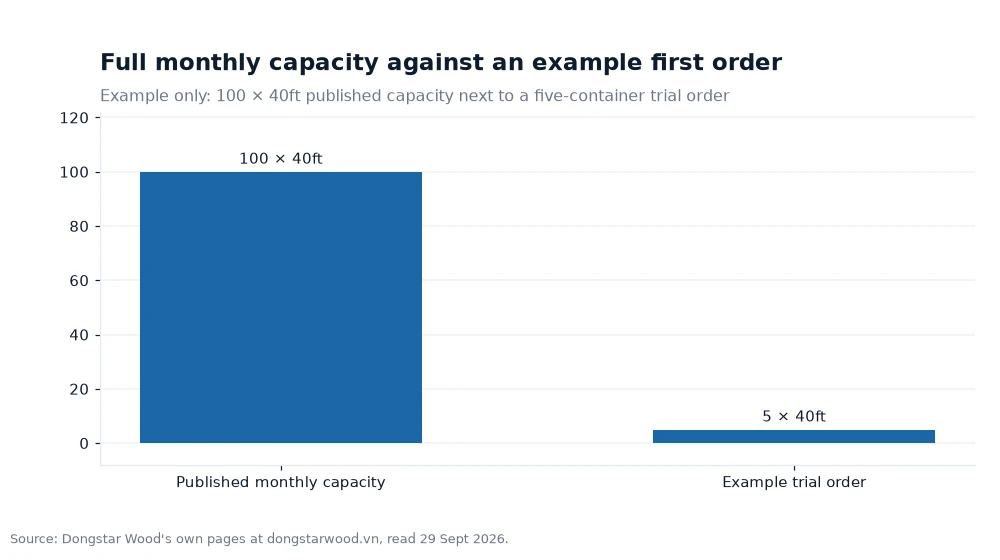
Take a five-container trial order against published capacity. 5 ÷ 100 = 5% of one month's output, and against the weekly rhythm of 25 containers it is 5 ÷ 25 = 20% of a week. That is small enough to be scheduled around existing production without displacing a larger account, which is exactly the position a first order should occupy.
Scale the same arithmetic up and the conversation changes. Forty containers is 40 ÷ 100 = 40% of a month, at which point the question is no longer price but line allocation: which product family gives way, and for how long. Buyers who know their percentage before they negotiate can ask for a schedule instead of a discount.
Frequently asked questions
What should a first container contain?
A specification the mill has confirmed in writing, a sample pulled from a running batch with its reference recorded, and a document set that covers the product rather than the factory. Those three contents decide whether the second order is a copy of the first.
Which documents travel with a first order?
The dated certificates for the ordered product, the EUDR due-diligence statement that links the consignment to its supply area, and the written duty treatment for the destination market. Request them at the order stage so they arrive with the goods.
How is a trial order scheduled against monthly capacity?
Published capacity above 100 × 40ft per month divides into 25 containers a week. A five-container trial is 5% of the month, small enough to be placed inside the running schedule without displacing a larger account.
From steps to a standing order
The practical payoff of a disciplined first container is a standing relationship rather than a single shipment. A Plywood Supplier that publishes its capacity and its certification set makes the second order a copy of the first. Compare the film faced plywood category against the formwork specification the project runs, then read the company profile to verify the founding year, the factory area and the compliance set in one place. A buyer who completes those steps once tends to find that the second container is scheduled before the first is emptied.
The figures shown were compiled from the company's published web pages on 29 Sept 2026[1].